
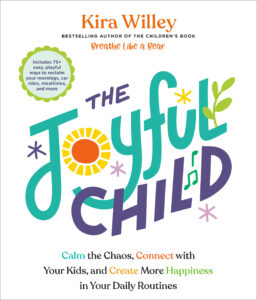
THE JOYFUL CHILD by Kira Willey (Book Excerpt)
 Protect unscheduled time for your child. Too many activities and not enough free time? You’re definitely not alone. In our desire to give our children every possible advantage (especially if we didn’t have those opportunities ourselves), we often fill our calendars to overflowing with sports, music lessons, dance team, and clubs.
But when every minute is planned, children lose the ability to direct themselves. Overscheduling creates a reliance on external structure and gratification, to the point where some children truly don’t know what to do when football practice is canceled, as they’ve become dependent on others to direct their time and energy.
I understand the privilege inherent in being able to provide these experiences, and I also understand the pull to sign up for all the things, especially if your child is asking and their friends seem to all be doing them. But finding the sweet spot between enrichment and overwhelm is crucial for your child’s healthy development. When we offset structured activities with plenty of free time, we support our children’s emotional well-being and their ability to manage themselves. It’s an essential balance to find.
I think of the things my kids created with their free afternoons—their made-up club with elaborate rules, the baseball dugout built from scrap wood, the bike trails they called the Rocky Mountains—that have become the stuff of family legend. Those unstructured hours created their most cherished memories and developed skills no structured activity could ever teach.
Let me be clear: I’m a huge fan of music instruction, learning of all kinds, and team sports. I played soccer and ran track through college, all my kids played on teams, and my son plays college soccer. For us, what worked was to do one sport at a time, not two or three, and we didn’t include additional things like piano lessons during the same season. That’s what worked for our family, but I’d never suggest that our approach is the universal solution—every child is unique, and your family has their own unique needs.
Mindful awareness is your most reliable guide for navigating this equation—not what anyone else says or what any other family is doing. Let your sister’s kids do two sports plus flute each season—good for them. Keep your eyes on your own game, so to speak, watching for signals from your child like irritability and crankiness or fatigue, which will likely mean they’re doing too much. Children need space to discover what they truly love and are drawn to, not just what we’ve signed them up for. This is how they develop independence, creativity, and a sense of self.
So, before you sign up for that next activity, ask yourself: “Will my child still have plenty of time and space with nothing planned on the calendar?” While unstructured playtime might mean your living room gets turned into a rather messy enchanted forest, the benefits for your child far, far outweigh the inconveniences.
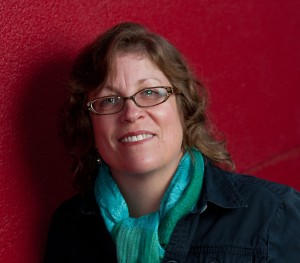
 Kira Willey is the author of seven bestselling children’s books that have been translated into twenty-four languages, including the #1 beloved bestseller Breathe Like a Bear. A world-renowned recording artist, Kira is also the co-creator and host of three PBS mindfulness, music, and yoga television shows and the creator of Rockin’ Yoga school programs. As a yoga teacher and lifelong musician, Kira’s unique and powerful method of integrating music and movement into joyful, child-centered mindfulness practices has resulted in millions of streams, more than half a million children’s book sales, and a massive, devoted fan base spanning the globe. A mother of three, she lives in eastern Pennsylvania.
Visit https://www.amazon.com/Joyful-Child-Connect-Happiness-Routines/dp/0593980603
Excerpted from THE JOYFUL CHILD: Calm the Chaos, Connect with Your Kids, and Create More Happiness in Your Daily Routines. Copyright © 2026 by Kira Willey. Excerpted by permission of Rodale Books, an imprint of Random House, a division of Penguin Random House, LLC. No part of this excerpt may be reproduced or reprinted without permission in writing from the publisher.